
Alphabet’s Google
SWOT ANALYSIS AND RECOMMENDATIONS

SWOT ANALYSIS
RATIONALE
STRENGTHS
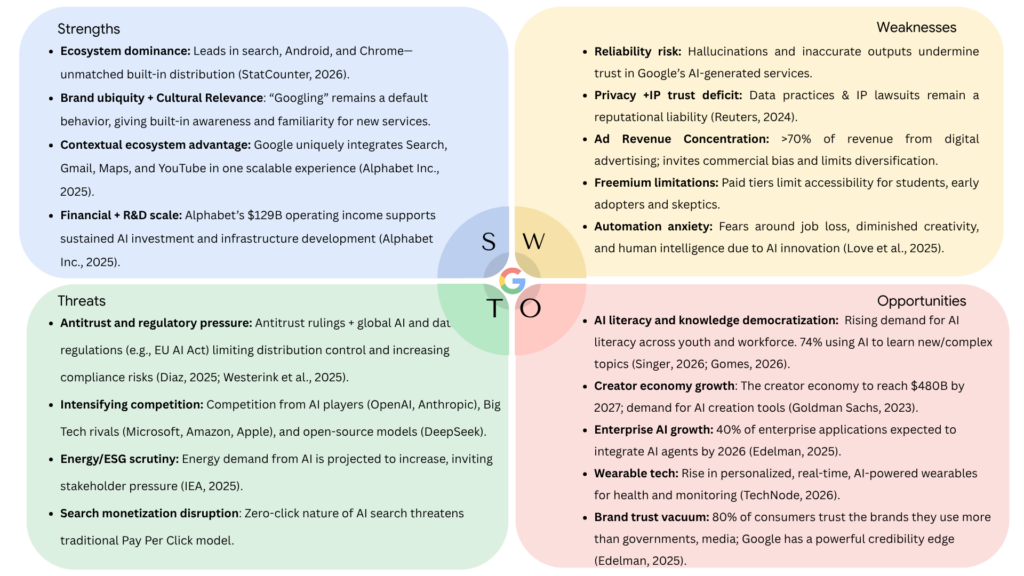
- Ecosystem Dominance: Google leads the global market share in search, mobile OS, and browser. Chrome holds over 65% of the global browser market and Android dominates mobile (StatCounter, 2026). This gives new services like Gemini an unmatched built-in distribution that no competitor can replicate through marketing spend alone. It is already embedded in the tools users regularly use.
- Brand Ubiquity and Cultural Relevance: “Googling” is a verb for search. This level of cultural integration represents its colossal brand equity. Users extend existing trust to new products like Gemini under the Google umbrella. This familiarity is a distinguishing advantage in the marketing purchase funnel.
- Contextual Ecosystem Advantage: Google uniquely integrates Search, Gmail, Maps, and YouTube into one scalable, interconnected experience (Alphabet Inc., 2025). This integration is a competitive edge, creating utility that other AI tools cannot match.
- Financial and R&D Scale: Alphabet reported $129 billion in operating income in 2024 (Alphabet Inc., 2024), funding sustained AI infrastructure investment at a scale that rivals cannot sustain. It enables long-term R&D, investments in new infrastructure, and absorbs regulatory costs.
WEAKNESSES
- Reliability Risk: Gemini (like all LLMs) can produce inaccurate or fictitious answers, causing high levels of distrust about the veracity and quality of AI-generated content among users, challenging the trust built by the Google search engine (Chakravorti, 2024).
- Privacy and IP Trust Deficit: Google’s history of data practices continues to affect trust. The company paid roughly $1.4B in privacy settlements in 2025, reinforcing public skepticism around how user data is collected and used ( Reuters, 2024)
- Ad Revenue Concentration: More than 70% of Alphabet’s revenue derives from digital advertising (Alphabet Inc., 2024), ties product design to monetization, creating tension as AI reduces clicks and raising user concerns around commercial bias in search result quality.
- Freemium Limitations: Paid subscription tiers create an access barrier for students, early adopters, and skeptical users who will not pay before they have experienced the product’s value. This slows adoption and exploration of Google’s full suite capabilities.
- Automation Anxiety: Fears around job loss and diminished human creativity remain widespread, particularly among younger generations navigating an uncertain labor market (Love et al., 2025). This is damaging because it creates psychological resistance to AI adoption across the board.
OPPORTUNITIES
- AI Literacy and Knowledge Democratization 74% of learners are now using AI to learn new or complex topics, and educators have emerged as AI’s new super users (Singer, 2026; Gomes, 2026). Alphabet has the infrastructure, the tools, and the brand trust and loyalty to lead the AI literacy movement for new generations in a way no competitor is currently positioned to do.
- Creator Economy Growth The creator economy is projected to reach $480 billion by 2027, driven by demand for accessible AI creation tools (Goldman Sachs, 2023). Google’s multimodal capabilities make it an ideal platform for the next generation of creators.
- Enterprise AI Growth 40% of enterprise applications are expected to integrate AI agents by 2026 (Edelman, 2025). Google Cloud and Workspace give Alphabet an existing stronghold to expand AI adoption among business users.
- AI-enabled wearable tech expansion: The rise of personalized, real-time, AI-powered wearables for health, emotion sensing, and wellness is shifting toward ambient, ‘always-on experiences’, creating opportunities for Google to extend its ecosystem beyond screens into ambient technology (TechNode, 2026).
- Brand Trust Vacuum 80% of consumers trust the brands they use more than governments or media (Edelman, 2025). In an era of institutional skepticism, Google’s long-term brand equity is a strategic asset to become a trusted voice on information access and emerging technology.
THREATS
- Antitrust and Regulatory Pressure A federal judge issued a major antitrust ruling against Google in 2025, penalizing its distribution practices (Diaz, 2025), while global AI regulations like the EU AI Act tighten compliance requirements (Westerink et al., 2025). This is a pressing threat because regulatory constraints on distribution directly limit Gemini’s ability to leverage Google’s ecosystem advantage.
- Intensifying Competition OpenAI, Anthropic, Microsoft, Amazon, and open-source models like DeepSeek are all competing aggressively for AI and technology mindshare. This is an existential threat to market position because switching costs for services are low, and users can migrate without much resistance. Brand loyalty and reputation, not capability alone, will affect long-term user retention.
- Energy and ESG Scrutiny AI energy demand is set to drive a significant surge in electricity consumption from data centers globally (IEA, 2025). As sustainability becomes a core parameter for all stakeholders, Alphabet’s growing energy footprint is an escalating reputational and operational risk. It requires transparency and innovation to retain and acquire consumer trust.
- Search Monetization Disruption: The zero-click nature of AI-generated search results threatens Google’s core Pay Per Click revenue model. The economic foundation of Alphabet’s business faces foundational pressure requiring quick realignment (Southern, 2025).
Recommendations
#1 Green Labs
Rationale:
The mounting environmental impact of AI development is being globally condemned and scrutinized, aggravating the existing Big Tech distrust and skepticism (National Education Association, 2025). Younger audiences (two-thirds of Gen Zs and millennials) rank environmental accountability as a strong brand preference (Westerink et al., 2025). While the environmental cost of AI technology is alarming, it also presents a powerful potential to address climate challenges. Google has already demonstrated this through initiatives such as Green Light (traffic emissions reduction), wildfire detection, flood forecasting, geospatial climate modeling, and more.
This initiative aims to reframe AI as solely being part of the environmental problem to being a visible and participatory solution.
Recommendation:
Launch ‘Green Labs program’ to enable educators, students, researchers, and developers to build and explore AI-powered climate solutions using Google infrastructure through partnerships with universities and climate organizations. Unlike selective sustainable start-up accelerators, Green Labs provides long-term infrastructural and institutional support towards AI use for greener causes. Publish these projects and innovations on social media and as an Annual Green Labs report, along with a section in the yearly Google Sustainability Report.
This could include partnerships like:
–Academic: Stanford Doerr School of Sustainability, MIT Climate & Sustainability Consortium
–NGOs / Climate orgs: World Resources Institute, Climate TRACE
–Public sector: City of Los Angeles (transport, wildfire, urban planning data)
This embeds Google’s AI infrastructure within the realm of up-and-coming sustainable technology development by opening and extending access to its proprietary technology for environmental sciences and innovation.
KPIs:
- 50+ global partnerships across universities, climate orgs, and startups in the first year.
- 20+ tier-1 press mentions linking Google AI to environmental innovation (WSJ, The Washington Post, Bloomberg, etc.).
- 10M+ impressions (views, likes, shares, downloads) with Green Labs content. (projects, tools, showcases) across owned and shared channels in the first year.
- 10% improvement across leading ESG benchmarks (Sustainalytics, MSCI, CDP) YoY.
#2 Gemini Student Creator Suite
Rationale:
AI literacy is rapidly becoming a foundational skill across both education and the future workforce. Yet, access to hands-on learning remains uneven, especially among younger users. At the same time, the projected $480B creator economy is redefining how individuals learn, create, and earn, with growing demand for tools that enable independent creation and upskilling (Goldman Sachs, 2023).
However, skepticism around AI’s impact on creativity and originality remains a concern, even among students and emerging creators. This creates a dual challenge of enabling access and information while proving that AI supports, and does not replace, human creativity.
This initiative positions Gemini as a co-creation tool for the next generation, embedding itself early in how students learn, build, and express ideas. This directly feeds the growing creator economy, establishing Google’s edge in a competitive AI tools market.
This includes:
- A low-cost, student-only Gemini subscription tier with enhanced access to creative tools (writing, video, coding, research). Not just a free trial.
- Special free student access to Gemini AI fluency courses (prompting, research, creative production, coding).
- A global ‘Gemini Creator Fellowship’ supporting top student innovators and storytellers across the US.
- Annual AI Creator Challenges / Hackathons focused on real-world problem solving.
- Showcasing student work through Google-owned platforms and creator partnerships on social media.
KPIS:
- 1M+ student sign-ups and active users within the first year.
- 75K+ submissions across creator challenges and fellowships.
- 40+ global partnerships with universities, student organizations, and creator platforms.
- 20+ tier-1 press mentions positioning Google as a leader in AI education and creativity (New York Times, Reuters, Fast Company, etc.)
#3 Gemini Trust Summit: The Standard for Responsible AI
Rationale:
As AI adoption accelerates, concerns around data privacy, copyright, misinformation, and ethical use are intensifying, contributing to a broader trust deficit facing AI giants like Google’s Gemini. Regulatory pressure is also increasing globally, with frameworks such as the EU AI Act pointing to a shift toward stricter compliance and accountability standards.
At the same time, ongoing copyright lawsuits and debates around AI training data are shaping a public perception that generative AI is anti-artist, dishonest, and extractive (Milmo, 2026). This signals a need for proactive leadership in defining responsible AI practices.
This initiative positions Google as a proactive participant in evolving AI with ethical and legal considerations at the forefront. It shows compliance with regulations around the world and opens global dialogue. This realigns Google’s narrative from reactive defense or silence to active leadership in advocacy and cooperation.
Recommendation:
Launch the Gemini Trust Summit, an annual global conference in San Francisco (streamed online) and an ongoing platform focused on open dialogue around AI ethics, policy, and governance.
This includes:
- A flagship annual summit featuring Google AI and development leaders as well as guest panels with leaders like Sam Altman (OpenAI), Dario Amodei (Anthropic), and Demis Hassabis (Google DeepMind).
- Participation from organizations such as Partnership on AI, Electronic Frontier Foundation (EFF), World Economic Forum, OECD AI Policy Observatory.
- Dedicated roundtables on copyright, training data transparency, youth protection, and misinformation.
- Publication of an annual Gemini Trust Report outlining commitments, learnings, and forward-looking standards.
- Regional forums to engage policymakers across the U.S., EU, and Asia.
This positions Google as not just a participant in the AI innovation race, but a leader defining how it is growing and evolving.
KPIs:
- 40+ global stakeholders (AI leaders, policymakers, NGOs) participating annually.
- 25+ tier-1 press mentions on Google as a pioneer in AI ethics and policy leadership (NYT, WSJ, Financial Times) post-summit within 2 months.
- 60K+ downloads and engagements with the Gemini Trust Report within a year.
- Representation (speaker invitations, panels, presentations) in 3+ major global forums invested in AI policymaking (WEF, OECD, EU AI discussions).